Thumbnail Photo: Glossy Ibis by Gray Richardson
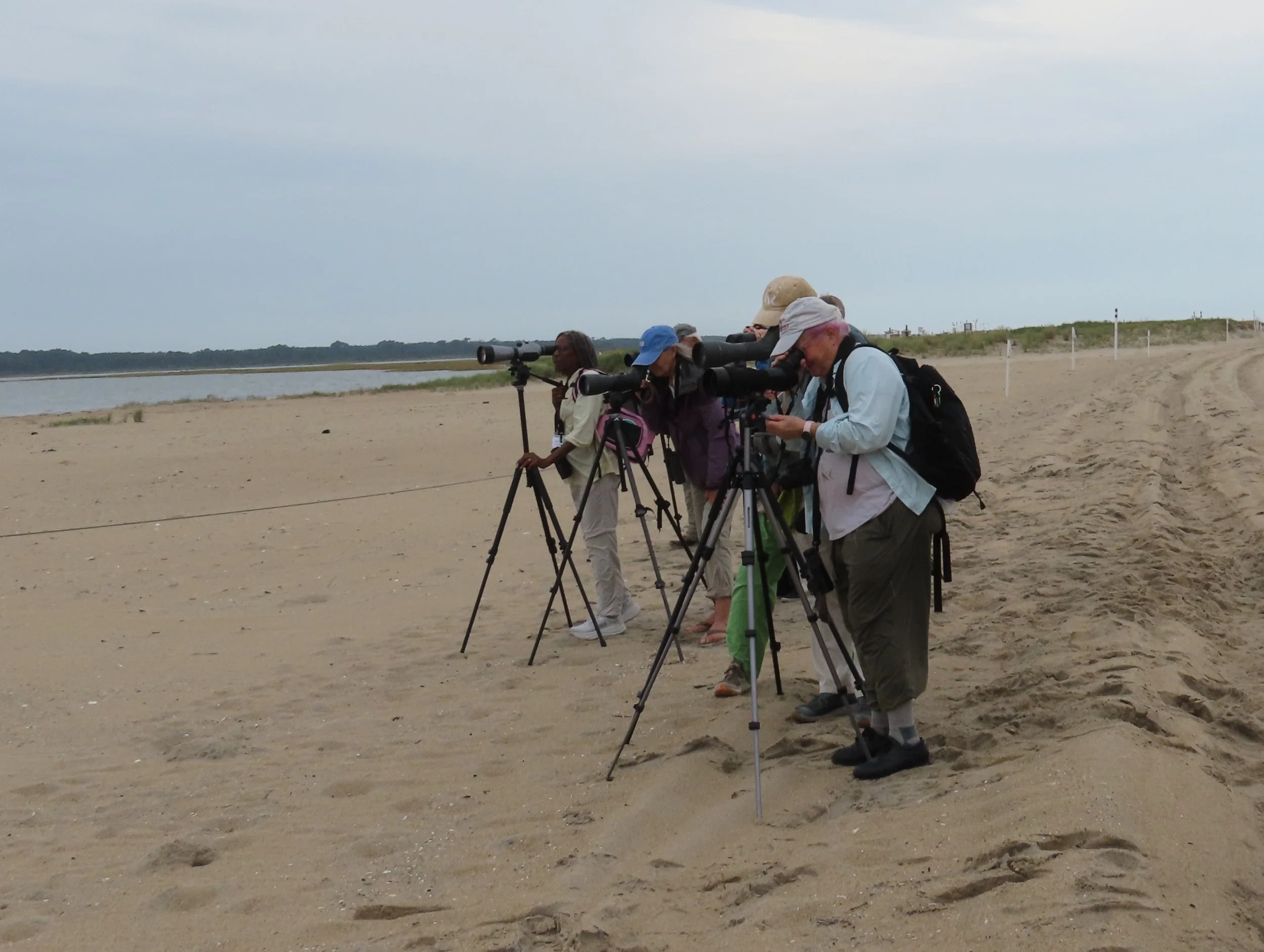
Over 100 avid birders descended on Chincoteague for the annual VSO Chincoteague Field Trip. We had a number of new to Chincoteague birders as well as those who schedule their fall around the trip. We gained 3 new members during the weekend and had two Canadians and their British friend join us on Sunday morning.
The weather (beyond our control) was a mixed blessing. Days were more temperate than is oft the case and the only rain was a light drizzle on Sunday morning. However, the rain did not deter our crew. A number followed Andrew Rapp from Tom’s Cove along the beach, stopping at groups of gulls, terns, and willets to have differential field marks identified as the individuals stood side to side. This nicely reinforced Jerry Via’s Zoom presentation on Tuesday. A Parasitic Jaeger flew by and swooped down on the massed terns and others, a nice reward for those who made it down to the beach. The gatherings at Tom’s Cove are usually productive and this year was no exception.
The downside of the good weather was that although each night showed a huge number of birds migrating overhead, they continued onward without dropping in. Despite the relatively low number of birds seen, there was good diversity with 146 bird species represented. (list of species is below)
A group of folks took advantage of the refuge trolley trip northward. Although this trip is not focused on birding, there were some excellent birds spotted, including a Wilson’s Phalarope. The trolley offered a good chance to see a bit more of the refuge while giving tired legs and feet a rest.
Others took advantage of the relatively mosquito-free loop walk at the Island Nature Trail. Nancy Barnett spotted our only Prothonotary Warbler there; several other warblers were seen there along with the Red-Headed Woodpecker. Those who braved the usually- more-buggy Woodland Trail also had good birds there.
The boat trips were a favorite as usual, with the requisite Bald Eagle spotting. Among others, we saw Marbled Godwits, Black-bellied Plover, and Willets (eastern and western) We struggled with the new split in the Willett species, learning that Chincoteague in September hosts mostly Western Willets.
The wildlife loop had water only on the north side. There we found the long-leggeds, including White Ibis, Glossy Ibis, and Egrets and Herons. The Clapper Rails made their regular appearance in the marsh below the boardwalk crossing the bridge to Assateague.
Many thanks to all who helped with the planning and execution of this field trip.
We are grateful to Jerry Via for his pre-trip Zoom preview of anticipated birds and for arranging details of the boat trips, as well as leading walks. Thanks to our other trip leaders: Bill Akers, Andrew Rapp, Lee Adams, Audrey Whitlock, Clark Olsen, Saundra Winstead and Morocco St. Andre, Charm and Pete Peterson. Special thanks to Nancy Barnhart who stepped in at the last minute to lead a trip and to keep the trip E-Bird lists for both boat rides.
We hope to see you next September 10-12 for the 2027 VSO Chincoteague Field Trip. The Refuge Inn will again be our host hotel.
SPECIES LIST
Canada Goose
Blue-winged Teal
Northern Shoveler
Mallard
American Black Duck
Wild Turkey
Pied-billed Grebe
Rock Pigeon
Mourning Dove
Yellow-billed Cuckoo
Chuck-will’s-widow
Chimney Swift
Ruby-throated Hummingbird
Clapper Rail
Black-necked Stilt
American Oystercatcher
Black-bellied Plover
Kildeer
Semipalmated Plover
Piping Plover
Snowy Plover
Wilson’s Plover
Whimbrel
Marbled Godwit
Ruddy Turnstone
Red Knot
Stilt Sandpiper
Sanderling
Dunlin
Least Sandpiper
Pectoral Sandpiper
Semipalmated Sandpiper
Western Sandpiper
Short-billed Dowitcher
Spotted Sandpiper
Solitary Sandpiper
Lesser Yellowlegs
Willet (Eastern and Western)
Greater Yellowlegs
Wilson’ Phalarope
Parasitic Jaeger
Bonaparte’s Gull
Laughing Gull
Ring-billed Gull
Herring Gull
Lesser Black-backed Gull
Great Black-backed Gull
Least Tern
Gull-billed Tern
Caspian Tern
Black Tern
Common Tern
Forster's Tern
Royal Tern
Sandwich Tern
Black Skimmer
Common Loon
Double-crested Cormorant
Brown Pelican
Great Blue Heron
Great Egret
Snowy Egret
Little Blue Heron
Tricolored Heron
Cattle Egret
Green Heron
Black-crowned Night-Heron
Yellow-crowned Night-Heron
White Ibis
Glossy Ibis
Black Vulture
Turkey Vulture
Osprey
Northern Harrier
Sharp-shinned Hawk
Cooper’s Hawk
Bald Eagle
Red-shouldered Hawk
Great Horned Owl
Belted Kingfisher
Red-headed Woodpecker
Red-bellied Woodpecker
Downy Woodpecker
Northern Flicker
Pileated Woodpecker
American Kestrel
Merlin
Peregrine Falcon
Great Crested Flycatcher
Eastern Kingbird
Eastern Wood-Pewee
Acadian Flycatcher
White-eyed Vireo
Philadelphia Vireo
Warbling Vireo
Red-eyed Vireo
Blue Jay
American Crow
Fish Crow
Carolina Chickadee
Tufted Titmouse
Tree Swallow
Purple Martin
Brown-headed Nuthatch
Blue-gray Gnatcatcher
Carolina Wren
House Wren
Marsh Wren
Gray Catbird
Northern Mockingbird
European Starling
Swainson’s Thrush
American Robin
House Sparrow
House Finch
American Goldfinch
Chipping Sparrow
Field Sparrow
Seaside Sparrow
Yellow-breasted Chat
Bobolink
Eastern Meadowlark
Baltimore Oriole
Red-winged Blackbird
Brown-headed Cowbird
Common Grackle
Boat-tailed Grackle
Black-and-white Warbler
Prothonotary Warbler
Common Yellowthroat
American Redstart
Cape May Warbler
Northern Parula
Magnolia Warbler
Bay-breasted Warbler
Yellow Warbler
Chestnut-sided Warbler
Black-throated Blue Warbler
Pine Warbler
Yellow-throated Warbler
Canada Warbler
Summer Tanager
Northern Cardinal
Rose-breasted Grosbeak
Blue Grosbeak
Indigo Bunting